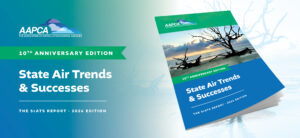
AAPCA Publishes 10th Anniversary Edition of State Air Trends & Success: The StATS Report
State and local agency leadership is key to achieving the next 10 years of clean air
May 8, 2026
Lexington, KY
This morning, the Association of Air Pollution Control Agencies (AAPCA) released the 2026 edition of State Air Trends & Successes: The StATS Report. In the tenth year of publication, the Association’s report spotlights state and local air agencies as essential to the significant improvement in air quality that has been achieved in the United States since the enactment of the Clean Air Act in 1970. The 2026 edition is being released in celebration of Air Quality Awareness Week, from May 4 to 8.
“We take pride in the continued success of state and local agency efforts to reduce air pollution across the United States, delivering on the mission to protect air quality and public health” stated AAPCA Vice President Cory Chism, Director of the Texas Office of Air.
The StATS Report catalogues key trends and metrics that are publicly available from federal, state, and local agencies, and includes data for criteria air pollutant concentrations and emissions, hazardous air pollutants (or air toxics), energy-related carbon dioxide, and visibility in national parks. Where applicable for context, trends for economic and social indicators like Gross Domestic Product, energy production, and population are included. The report is divided into sections on “AAPCA Member State Air Trends & Successes,” “American Air Quality in an International Context,” and “Air Quality Trends in the United States.”
Commenting on the report, AAPCA Past-President Laura Crowder, Director of the West Virginia Division of Air Quality, noted that “AAPCA’s members are responsible for sustained and effective implementation of longstanding Clean Air Act programs by strategically deploying resources, creating efficient programs and best practices, and relying on leadership and staff that are dedicated public servants.”
The StATS Report showcases AAPCA Member leadership: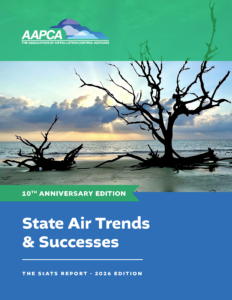
- Collectively from 2000 to 2024, AAPCA Members States achieved a 44 percent decrease in the combined emissions of the pollutants (or pollutant precursors) for which there are national ambient air quality standards, or NAAQS.
- From 2000 to 2024, AAPCA Members States achieved a 94 and 86 percent decrease in emissions of sulfur dioxide (SO2) and oxides of nitrogen (NOX), respectively, from the electricity sector. Over nearly the same period (2000 – 2023), AAPCA Member States reduced energy-related carbon dioxide (CO₂) emissions by 17 percent. Emissions reductions were achieved even as total energy production in AAPCA Member States increased by 63 percent from 2000 to 2023.
- From 2014 to 2024, reported toxic air releases in the United States declined by 30 percent and AAPCA Member States were responsible for about 65 percent of the total reduction.
Case studies featured in the 2026 edition of The StATS Report include:
- A regional haze case study of the Texas Big Bend National Park, which despite considerable influence from international sources, is demonstrated to be already meeting its 2028 reasonable progress goal under the regional haze program.
- A local program case study detailing San Luis Obispo County’s achievements in reducing coarse particulate matter concentrations by restoring dune vegetation in coastal California to provide dust control benefits.
National trends from the 2026 edition of State Air Trends & Successes: The StATS Report show:
- From 1970 to 2024, the United States reduced aggregate emissions of criteria air pollutants under the NAAQS programs by 79 percent.
- In 2024, monitored concentrations of all criteria pollutants as well as estimated emissions of all criteria pollutants and precursors remain below 2010 levels.
- From 2000 to 2023, the United States reduced energy-related CO₂ emissions by 19 percent while experiencing a 44 percent increase in total energy production.
- On average from 2000 to 2024, visibility in national parks and wilderness areas improved by 38 percent on the 20 percent clearest days, and 29 percent on the 20 percent most impaired days.
The 2026 edition of AAPCA’s State Air Trends & Successes: The StATS Report is available at: https://cleanairact.org/wp-content/uploads/2026/05/2026_AAPCA_StATS_Report_FINAL-FOR-DISTRIBUTION.pdf
The U.S. Environmental Protection Agency (EPA) hosts Air Quality Awareness Week (#AQAW2026) with federal partners and state, local, and tribal agencies. The 2026 daily themes are: Wildland Fires and Smoke; Asthma and Your Health; Indoor Air Quality; and Air, Animals, and Plants. More information about AQAW can be found here.
AAPCA Background
The Association of Air Pollution Control Agencies (AAPCA) is a national, non-profit, consensus-driven organization focused on assisting state and local air quality agencies and personnel with implementation and technical issues associated with the federal Clean Air Act. Created in 2012, AAPCA represents 53 state and local air pollution control agencies, and senior officials from 21 state environmental agencies currently sit on the AAPCA Board of Directors. AAPCA is housed in Lexington, Kentucky as an affiliate of The Council of State Governments. More information about AAPCA can be found at www.cleanairact.org.
Association of Air Pollution Control Agencies | 1776 Avenue of the States | Lexington, Kentucky 40511
www.cleanairact.org | @AAPCA_States | LinkedIn
Contact: Morgan Dickie, Executive Director (mdickie@csg.org / 859-244-8043)